Maenporth Beach
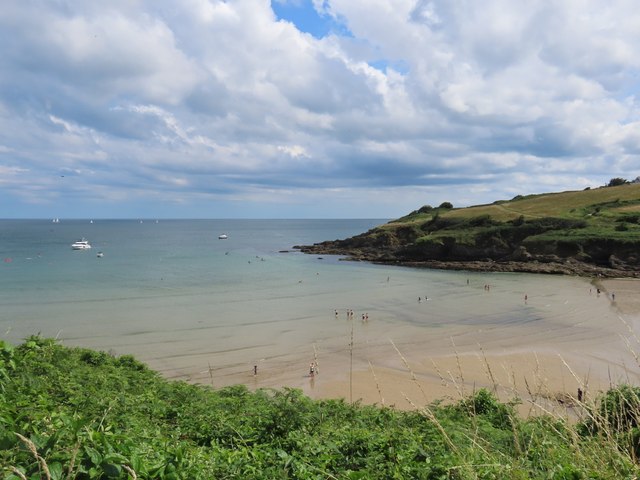
Maenporth Beach is a small, sheltered cove situated on the southern coastline of the Fal estuary peninsula in Cornwall, England, lying just a few miles south of Falmouth. The beach sits within a quiet, wooded valley where a stream meets the sea, giving it a distinctly intimate and tranquil character compared to many of Cornwall's more famous and crowded beaches. Its relative obscurity has long been part of its appeal — those who find it tend to return repeatedly, drawn by its calm atmosphere, gentle surroundings, and the sense that it has not been overwhelmed by mass tourism. The cove faces roughly south-southeast, which provides it with reasonable shelter from prevailing south-westerly winds, and on calm summer days the water can take on a notably clear, greenish quality that feels almost Mediterranean in character, though the reality of Cornish sea temperatures quickly dispels that illusion.
The beach itself is composed primarily of coarse sand mixed with shingle and some small pebbles, giving the surface a slightly firmer texture than the fine golden sands found at larger Cornish beaches such as Carbis Bay or Perranporth. At low tide, a reasonably wide expanse of sand is revealed, making it suitable for walking, building sandcastles, and relaxing, though the usable beach area diminishes noticeably as the tide rises. The beach is flanked on both sides by low, grass-covered cliffs and rocky outcrops, and the valley behind it is densely wooded, which creates an enclosed, almost secretive feel. Rocky platforms extend from each end of the cove, offering rock pooling opportunities at lower tides, where crabs, anemones, small fish, and various molluscs can be found in the shallow pools left by the retreating sea.
The waters at Maenporth are generally calmer than those found on Cornwall's exposed north coast, making it a more forgiving environment for casual swimmers and families with younger children. The tidal range in this part of Cornwall is significant, as it lies within the broader influence of the Celtic Sea tidal system, and the beach can look dramatically different between high and low water. Currents are generally mild within the cove itself, though swimmers should always be aware of conditions, and the water temperature follows typical South West England patterns — cold in spring, reaching around 16 to 18 degrees Celsius at peak summer, and dropping back down sharply through autumn and winter. The cove does not typically generate the powerful surf found on the Atlantic-facing north Cornish coast, meaning it is not a significant surfing destination, but its calmer conditions make it well-suited for swimming and paddling.
Maenporth has a modest but practical set of facilities for visitors. There is a car park close to the beach, which is run by the local authority and charges a fee during the peak season — this is one of the primary practical considerations for visitors, as the lane leading down to the beach is narrow and the car park capacity is limited. Toilet facilities are available near the beach, and the Maenporth Beach Café and Restaurant has become something of a local institution, offering food and drinks with views over the cove. The café is well-regarded in the area and draws visitors even on cooler days when swimming is not the primary activity. The beach does not have permanent RNLI lifeguard coverage throughout the season in the same way that larger Cornish beaches do, so swimmers should exercise independent judgment about conditions. Accessibility to the beach itself is reasonably good from the car park, though the terrain is not entirely flat.
The best time to visit Maenporth depends on what a visitor is seeking. In July and August the beach fills up quickly on sunny days, and parking can become difficult by mid-morning. Those seeking a quieter experience would do well to visit early in the morning, on weekdays, or during the shoulder seasons of late May, June, or September, when the weather can still be pleasant but the crowds thin considerably. Low tide visits offer the largest beach area and the best rock pooling. In winter, the beach takes on an entirely different personality — the wooded valley becomes atmospheric and wild, occasional storms push large swells into even this sheltered cove, and the experience becomes more about dramatic coastal scenery than leisure. Winter walks along the coastal path from Maenporth can be extraordinarily beautiful, with the bare trees of the valley behind the beach contrasting with the grey-green sea.
Activities at Maenporth are well-suited to those seeking gentle, family-oriented coastal recreation rather than adrenaline-fuelled water sports. Swimming is the primary summer activity, and the calmer waters make it accessible to a wider range of abilities than the surf beaches to the north. Kayaking and paddleboarding are popular pursuits, with the sheltered nature of the cove providing a good launch point for exploring the nearby coastline, including the outer reaches of the Helford River estuary to the south-west. Rock pooling is a perennial favourite for children and adults alike, given the rocky margins of the cove. The South West Coast Path passes near or through the area, making Maenporth a popular starting or finishing point for coastal walks, including routes towards Swanpool Beach to the north or along the more rugged coastline towards the Lizard Peninsula to the south.
The surrounding landscape is characteristic of this part of south Cornwall — a softly undulating agricultural and wooded countryside dropping steeply to a ragged coastline of coves and headlands. The valley behind Maenporth is thickly wooded, and the stream that runs through it, known as the Maen Valley, adds to the enclosed, sheltered feeling of the location. The cliffs around the cove are not the dramatic, sheer faces found elsewhere in Cornwall, but they are covered in coastal scrub and provide pleasant elevated walking. The proximity to the Helford Passage and the broader Falmouth Bay area means that on clear days there are fine views along the coast in both directions, and the sea can take on a remarkable variety of colours depending on the weather and light conditions.
Maenporth sits within easy reach of Falmouth, which is approximately three miles to the north, making it a convenient destination for visitors staying in that town or its surroundings. The beach is accessed via a narrow lane from the Falmouth area, and this access road is something visitors should be prepared for — it is typical of many Cornish coastal access routes in being single-track with passing places in sections. There is no entrance fee to the beach itself, only the car parking charge. Visitors coming from outside the area would typically approach via the A39 road to Falmouth and then follow local signage southward toward the beach. The combination of proximity to a sizeable town with its full range of accommodation, restaurants, and attractions, while still feeling genuinely secluded, is one of Maenporth's most distinctive practical virtues.
The history of Maenporth, like many small Cornish coves, is intertwined with fishing and the maritime heritage of the area. The name itself is Cornish in origin, with "Maen" meaning stone and "porth" meaning cove or harbour, reflecting the rocky character of the location and the common Cornish pattern of descriptive place naming. The broader Falmouth area has an extraordinarily rich maritime history as one of Britain's most important deep-water harbours, and the smaller coves along this stretch of coast would historically have served local fishing communities and, during less law-abiding centuries, likely played a role in the smuggling trade that was endemic throughout Cornwall. The Second World War saw significant activity in Falmouth Bay and its surrounding waters, with the harbour serving as a major embarkation point, and the quiet coves along this stretch of coast have their own quieter connections to that period. Today Maenporth carries this layered past lightly, presenting itself primarily as a place of peaceful natural beauty rather than historical spectacle, which suits both the landscape and those who seek it out.