Kilmeedy Castle
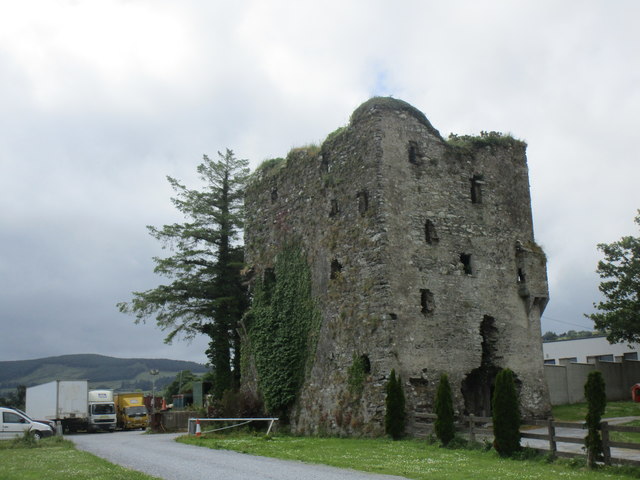
Kilmeedy Castle stands as a ruined tower house in County Kerry, located in the townland of Kilmeedy in the barony of Trughanacmy, in the southwestern corner of Ireland. Tower houses of this type are quintessentially Irish medieval structures, built predominantly between the 14th and 17th centuries, and this example represents the kind of fortified domestic residence that once dotted the Kerry landscape in considerable numbers. While not among the most famous of Kerry's many castles, it holds genuine historical and archaeological interest as a remnant of the Gaelic and later Norman-influenced lordship that characterized this part of Munster before the upheavals of the early modern period. Its survival, even in ruined form, makes it a tangible connection to the medieval world of southwest Ireland, a world of competing clans, seasonal agricultural rhythms, and a deeply localized political order.
The broader area around these coordinates sits in the hinterland between the town of Killarney to the north and the market town of Millstreet just across the Cork border to the east, in a landscape that transitions between the dramatic mountain ranges of Kerry and the gentler rolling farmland of the interior. The barony of Trughanacmy was historically associated with the MacCarthy Mór dynasty and its various branches, who were among the most powerful Gaelic lords of Munster throughout the medieval period. Tower houses throughout this region were typically either MacCarthy strongholds or those of their subordinate lords and allied families, used as centers of local authority and agricultural management. Without a specific documentary record tying this particular tower to a named lord or event that I can confirm with certainty, it would be irresponsible to attribute it definitively to one family, but the MacCarthy sphere of influence is the overwhelmingly likely context for its construction.
Physically, Kerry tower houses in this interior zone tend to share certain characteristics: roughly square or rectangular plans of rubble limestone or sandstone construction, rising several storeys with walls of considerable thickness, narrow window openings, and in many cases a surviving bawn wall or traces of one enclosing a small courtyard. In a ruined state, as is typical for unrestored examples across rural Kerry, the structure may lack its upper floors and roof, leaving open sky where great timber beams once held the living spaces together. The stone takes on the silver-grey and mossy green hues characteristic of Kerry masonry, especially in a wet climate where lichen colonizes old walls with particular enthusiasm. Standing near such a structure, one becomes aware of the weight of the masonry, the depth of the window embrasures, and the way the thick walls would have made these buildings simultaneously cold and defensible.
The surrounding countryside at these coordinates is pastoral and relatively quiet, the kind of Irish rural landscape defined by small fields bounded by stone walls and hawthorn hedges, with farmsteads scattered across gently undulating ground. The Deenagh and Flesk river valleys are not far distant, and the whole region carries the characteristic Kerry atmosphere of soft light filtered through Atlantic weather systems, with cloud shadows moving rapidly across green hills. The Paps of Anu, those distinctively shaped twin summits sacred in Irish mythology, are visible from much of this part of Kerry on a clear day, lending the landscape a deeper mythological resonance that predates any medieval castle by millennia. The proximity to Killarney means that visitors to the broader region have easy access, though this particular site sits away from the main tourist corridors.
For visitors, it is worth noting that rural tower house ruins in Ireland of this type are very often on or adjacent to private farmland, and access considerations are therefore significant. There is no formal visitor infrastructure at a site of this nature — no car park, interpretive panels, or managed pathway — and the approach is likely via narrow country roads. The best approach for anyone wishing to visit is to consult the Ordnance Survey Ireland mapping (available via the OSi website or apps such as MapsIreland) to identify the precise access point, and to seek permission from any landowner if the structure sits within a working farm. The National Monuments Service of Ireland maintains records of protected structures, and this castle, like virtually all surviving tower houses, will be recorded on the Record of Monuments and Places, giving it a degree of legal protection. Summer months offer the most comfortable walking conditions and the longest daylight hours, though the Irish interior is green and atmospheric year-round.
One of the quietly remarkable aspects of sites like Kilmeedy Castle is how thoroughly they have been absorbed back into the working agricultural landscape. Unlike the showcase castles of Kerry — Ross Castle on Lough Lein, or Carrigafoyle near the Shannon estuary — a ruin of this scale and remoteness tends to exist without fanfare, known primarily to local farmers and to the dedicated community of amateur historians, heritage enthusiasts, and walkers who seek out Ireland's lesser-documented medieval survivals. The very ordinariness of its setting is part of its interest: this was not a seat of great kings but a local node in a network of power, the home perhaps of a tánaiste or a minor lord, and its quiet persistence in a field corner is its own kind of testimony to the density of medieval habitation across what is today sometimes perceived as empty countryside.