Sandsfoot Castle
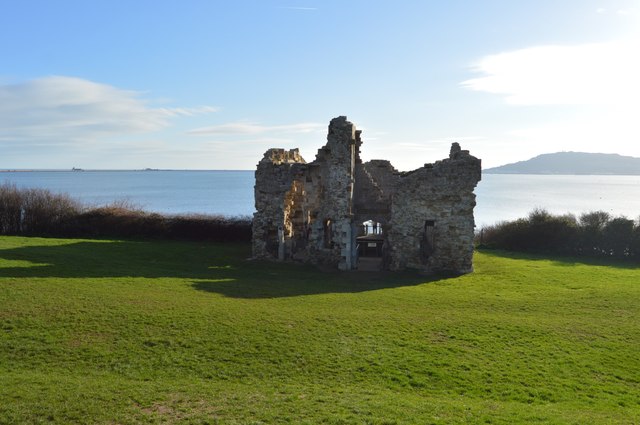
Sandsfoot Castle is a ruined Tudor artillery fortification perched on a rocky promontory on the western shore of Portland Harbour, in the town of Weymouth, Dorset. It is one of a pair of castles built by Henry VIII in the 1530s and 1540s to guard the anchorage of Portland Roads, with its companion fortification, Portland Castle, sitting directly across the water on the Isle of Portland. While Portland Castle has survived in remarkably good condition, Sandsfoot presents a more romantic and melancholy spectacle — a substantial fragment of wall and tower clinging to an eroding clifftop, slowly being claimed by the sea and the elements. This precarious state of preservation, paradoxically, adds enormously to its atmospheric appeal, making it one of the more evocative and quietly dramatic coastal ruins in the south of England.
The castle was constructed around 1539 to 1542 as part of Henry VIII's ambitious coastal defence programme, itself a response to the very real threat of invasion from Catholic Europe following his break with Rome. Pope Paul III had effectively called for a crusade against England, and both France and the Holy Roman Empire were momentarily at peace with one another, freeing them to consider joint military action. Henry responded by commissioning a chain of coastal forts stretching from Kent to Cornwall, and Sandsfoot — along with Portland Castle — was designed to protect the deep natural anchorage of Portland Roads, which offered one of the best sheltered harbours on the entire English south coast. The name Sandsfoot likely derives from the sandy ground or sandstone geology at the foot of the low cliff on which it stands, though the exact etymology has never been definitively settled.
The castle was built in the characteristic D-plan style favoured by Henry's military engineers, with a rectangular residential block and a rounded artillery platform facing seaward. It was designed to mount heavy cannon that could engage enemy ships attempting to enter Portland Roads, working in concert with the guns at Portland Castle to create a crossfire across the anchorage. For much of the sixteenth century it served as an active coastal fortification and residence for its captain, and in 1588, during the anxious weeks of the Spanish Armada campaign, it would have been fully manned and on high alert as the great fleet was spotted sailing up the Channel just offshore. The castle saw no direct action during that crisis, but its strategic purpose was never more keenly felt than in those summer weeks.
By the seventeenth century, Sandsfoot had already begun to fall into decay. The soft limestone and clay of the cliff edge proved an unreliable foundation, and as the coastline eroded, sections of the structure began to slip and collapse. Much of the castle's fabric was lost over subsequent centuries, and what remains today is essentially the eastern residential range — a roofless shell of ashlar masonry perhaps ten to fifteen metres high in places — along with fragments of walling and a sense of the original plan. The ruins were eventually taken into the care of Weymouth and Portland Borough Council, and the surrounding land was laid out as a small ornamental garden, which in some ways suits the remnant perfectly, framing the old stone in greenery and creating a sheltered, contemplative space beside the water.
In person, Sandsfoot Castle is a genuinely striking place to stand. The remaining wall of the residential range rises sharply above the cliff edge, and through the empty window openings there are long views across Portland Harbour toward the Isle of Portland and Chesil Beach beyond. The stonework is weathered to warm honey and grey tones, lichen-covered and softened by centuries of salt air. The sound of the sea is ever-present — gulls calling overhead, the distant hiss of water on shingle below, and on rougher days the low rumble of waves against the rocky foreshore. The garden around the ruin is well tended and pleasant, with mature trees providing shade, and on a calm day the whole setting has an air of gentle melancholy that feels entirely in keeping with a place slowly surrendering itself to the sea.
The surrounding area is rich with interest. The town of Weymouth lies immediately to the north, with its handsome Georgian seafront, sandy beach, and harbour full of working boats and pleasure craft. To the south, the remarkable natural causeway of Chesil Beach stretches for miles, and beyond it the Isle of Portland rises as a flat-topped limestone plateau, its quarries, lighthouse, and bird observatory making it a destination in its own right. The South West Coast Path passes close by, and walkers can follow the shoreline to enjoy extensive views across one of the most historically significant anchorages in Britain — Portland Harbour itself was extensively used by the Royal Navy and was a base for D-Day operations in 1944. The whole area forms part of the Jurassic Coast UNESCO World Heritage Site, which extends along this stretch of Dorset coastline.
Visiting Sandsfoot Castle is straightforward and free of charge. The ruins and garden are managed as a public open space and are accessible throughout the year, though the garden itself may have seasonal opening hours for its gates. The site is reached via Castle Cove Road in Weymouth, and there is limited parking nearby. The castle sits just above Castle Cove, a small and popular shingle and rock beach that is beloved by local swimmers and snorkellers, and the two can easily be combined in a single visit. The approach on foot along the coastal path from Weymouth town centre takes around thirty to forty minutes and is a very pleasant walk. The site is broadly accessible on level ground around the garden, though the cliff edge itself and some parts of the ruins require care. The best times to visit are on clear days when the views across the harbour are at their finest, and spring and early summer bring the added pleasure of the garden in bloom.
One of the more poignant aspects of Sandsfoot's story is precisely how much has already been lost to the sea. Historical records and early illustrations suggest a considerably more complete structure existed as recently as the eighteenth and nineteenth centuries, and the process of coastal erosion continues today. In a sense, every visit is to a place in the process of disappearing, which gives it a quiet urgency quite distinct from the more static experience of a well-preserved heritage site. There is also a local tradition, not well documented but persistent, that the eroding cliff has over the years yielded finds of Tudor-period material — fragments of pottery, worked stone, and iron — carried down to the beach below, as if the castle is slowly returning itself to the earth piece by piece. For a place built to project military power and permanence, there is something deeply humbling about its current condition, and that tension between original ambition and present fragility is, for many visitors, precisely what makes Sandsfoot Castle so memorable.