Barclodiad y Gawres
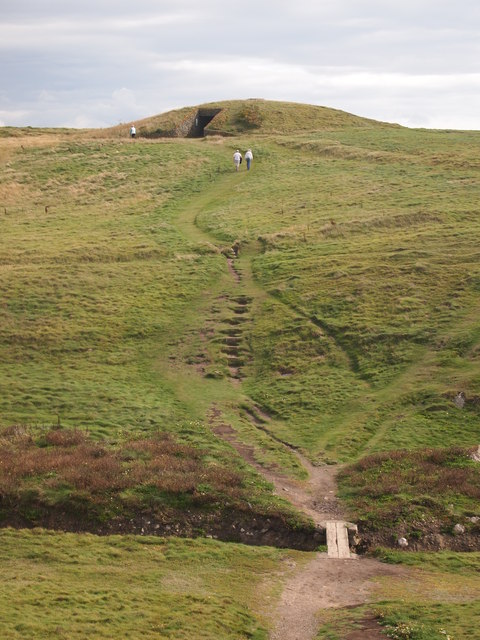
Barclodiad y Gawres is a Neolithic chambered tomb and passage grave situated on a clifftop headland on the west coast of Anglesey, the large island off the northwest tip of Wales. Dating to approximately 3000 BCE, it is one of the most important prehistoric monuments in Wales and arguably one of the finest examples of a decorated passage grave in the entire British Isles. What makes it especially remarkable and sets it apart from the many chambered cairns scattered across Wales is the presence of abstract carved designs on five of its interior stones — spirals, zigzags, lozenges, and chevrons — which are closely related to the famous megalithic art found at sites like Newgrange and Knowth in Ireland's Boyne Valley. This connection to Irish passage grave art is genuinely extraordinary, suggesting deep cultural and perhaps kinship ties across the Irish Sea during the Neolithic period, and it places Barclodiad y Gawres within a wider Atlantic megalithic tradition that stretched from Iberia to Orkney.
The name itself is wonderfully evocative: in Welsh, "Barclodiad y Gawres" translates roughly as "the Apronful of the Giantess," a reference to a local legend in which a giant woman, striding across the landscape, let fall from her apron a collection of stones that formed the tomb. This kind of giant-associated folk etymology is common across the British Isles, where later populations who had no cultural memory of the Neolithic builders often attributed such massive and mysterious structures to supernatural beings. The legend speaks to how striking and inexplicable the cairn must have seemed to later inhabitants of Anglesey, who could not easily account for how such enormous stones had been gathered and arranged by purely human hands.
The tomb was excavated in 1952 and 1953 by archaeologists T.G.E. Powell and Glyn Daniel, whose work revealed a cruciform passage grave beneath the reconstructed cairn mound. The structure follows the classic passage grave plan: a long entrance passage leads to a central chamber from which three subsidiary side chambers open out, forming the cross shape typical of Irish-influenced tombs. During excavation, the remains of two cremated individuals were found in the central chamber, along with animal bones and ash. Most strikingly, a strange stew or broth-like deposit was discovered in a pit at the centre of the chamber — it contained the bones of frog, toad, grass snake, eel, and hare, mixed together in a way that strongly suggests some form of ritual activity, possibly a funerary feast or magical ceremony associated with the burial rites. This peculiar concoction has captured the imagination of archaeologists and visitors alike for decades, hinting at spiritual practices that remain tantalisingly beyond full understanding.
Standing at the site itself, one is immediately struck by the setting as much as by the monument. The tomb sits on a low, grassy headland jutting into the sea just south of the village of Llanfaelog, with the wide sweep of Cable Bay (Porth Trecastell) visible to the south and the open waters of Caernarfon Bay stretching westward toward Ireland. On a clear day the mountains of the Llŷn Peninsula are visible across the water, and the Wicklow Mountains of Ireland occasionally appear on the horizon, making the connection between this tomb and the Irish passage grave tradition feel almost viscerally real. The wind is almost constant here, rushing in off the sea with the smell of salt and wet grass, and on rougher days the sound of waves breaking against the rocks below provides a constant, low roar. Seabirds — gulls, cormorants, and in season choughs — wheel overhead. It is a landscape that feels ancient and exposed, thin-skinned, as if the centuries lie just beneath the surface of the turf.
The exterior of the monument presents itself as a large circular mound, reconstructed and consolidated after excavation, and is accessed through a locked iron gate fitted with a combination mechanism. Access is managed by Cadw, the Welsh Government's historic environment service, and the key to the gate can be collected from a nearby café or local contact point, a practical arrangement that allows the interior to be preserved while remaining open to visitors. Inside the low passage, which requires crouching and shuffling forward through the dark, a torch is essential — the passage is unlit, and without artificial light it becomes extremely dark within a few metres of the entrance. The carved stones within are not always immediately obvious to an untrained eye, as the geometric markings are shallow and can be obscured in certain lighting conditions; a good torch held at an oblique angle to the stone surface is the best way to make the carvings reveal themselves. The experience of emerging into the central chamber and letting your eyes adjust while knowing you are surrounded by 5,000-year-old artwork is genuinely humbling.
The immediate surroundings offer considerable additional interest. Cable Bay itself, just a short walk down the slope from the tomb, is a beautiful sandy beach that is popular with surfers and families in summer but remarkably quiet out of season. The coastal path links Barclodiad y Gawres with the wider Anglesey Coastal Path, and walks in either direction along the cliffs reward visitors with dramatic views and further prehistoric and natural interest. The area is part of a landscape rich in Neolithic and Bronze Age remains; Anglesey as a whole has an exceptional concentration of prehistoric sites, and this corner of the island also lies close to the sites associated with the Druids and the Roman destruction of their sacred groves. Holy Island and the dramatic sea stacks of South Stack lighthouse are within comfortable driving distance, as is the village of Aberffraw, which was once the principal seat of the medieval Princes of Gwynedd.
For practical purposes, the site is reached by taking the A4080 coastal road that runs along the southwest coast of Anglesey between Aberffraw and Rhosneigr. There is a small car park near Cable Bay from which the tomb is a short and easy walk uphill along a footpath. The nearest town of any size is Llangefni inland, while Rhosneigr to the north has cafés, accommodation, and shops. The site is managed by Cadw and admission is free, though arranging access to the interior requires collecting the gate key in advance or on the day. The best times to visit are late spring and early summer when the coastal wildflowers are in bloom, visibility across the sea is often at its best, and the area is not yet crowded with summer holidaymakers. Winter visits have their own austere beauty, though the path can be muddy and the wind ferocious. At any time of year, wear layers and expect the weather to change rapidly — this is the exposed west coast of Wales, and the sea makes its presence felt in the climate as much as in the view.