Domen Ddreiniog
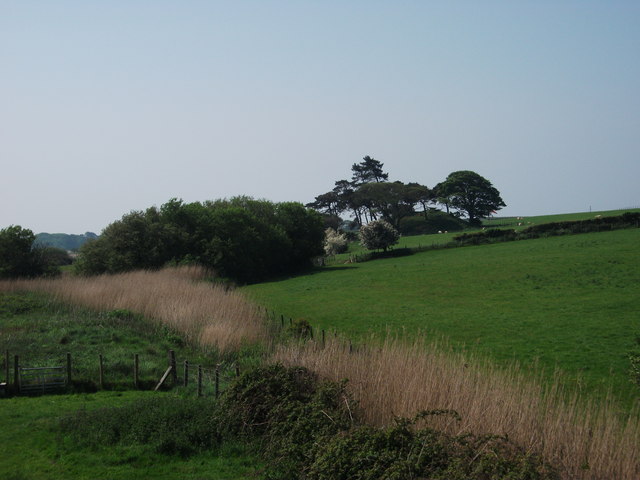
Domen Ddreiniog is a prehistoric burial mound, or tumulus, located in the Dysynni Valley area of Gwynedd in mid-Wales. The name translates roughly from Welsh as "Thorny Mound" or "Brambly Mound," a reference to the scrubby vegetation that characteristically colonises such earthen monuments over the centuries. It belongs to the tradition of Bronze Age funerary monuments that are scattered across the uplands and valley margins of Wales, constructed by communities who inhabited this landscape somewhere between approximately 4,000 and 2,500 years ago. Such cairns and barrows were not merely graves but statements of territorial identity, ancestral claim, and cosmological belief, marking the land as inhabited and meaningful across generations. Domen Ddreiniog is considered a scheduled ancient monument, affording it legal protection under Welsh heritage law.
The mound sits within a landscape that has been sacred and settled since prehistoric times. The Dysynni Valley and the broader area around Tywyn and the lower slopes of Cadair Idris are rich in archaeological remains, from standing stones to hillforts, reflecting continuous human engagement with this terrain across millennia. The Bronze Age communities who built monuments like Domen Ddreiniog would have lived in a world where the boundary between the living and the ancestral dead was thin and ritually significant, and the placement of burial mounds in prominent or liminal positions in the landscape was deliberate. Though no specific legends are firmly attached to this particular mound in the surviving folklore record, such earthen mounds throughout Wales were commonly associated in later folk tradition with the Tylwyth Teg, the fairy folk, or with the restless dead, and it would be surprising if this one escaped entirely such imaginative elaboration among the local Welsh-speaking community.
Physically, the mound presents as a rounded earthen rise in the landscape, modest in height compared to the great barrows of southern England but nonetheless distinctive against the flat or gently rolling ground nearby. Its surface is likely clothed in rough grass, bracken, and possibly gorse or bramble — hence its name — giving it a slightly untamed appearance compared to the managed pasture surrounding it. Standing beside it, one becomes aware of the sheer age of the structure, the sense that human hands moved and shaped this earth with intent and ceremony at a time when the landscape would have looked markedly different, more wooded in the valley floor perhaps, but already heavily grazed on the upland margins. The silence in this part of Wales, broken only by wind, birdsong, and distant sheep, makes the contemplative weight of such a monument feel particularly immediate.
The surrounding landscape is one of considerable natural beauty. The Dysynni Valley opens toward the Cardigan Bay coastline near Tywyn, while inland the ground rises toward the dramatic massif of Cadair Idris, one of the most celebrated mountains in Wales. The valley itself carries the River Dysynni and is flanked by notable landmarks including the remarkable Craig yr Aderyn, or Bird Rock, an inland cliff that is one of the very few places in the world where cormorants nest far from the sea. The area is part of the Snowdonia National Park region and its margins, and the combination of coastal accessibility, river valley, and mountain backdrop gives it a layered ecological and scenic richness. Small farms and traditional Welsh rural settlement patterns characterise the human geography of the area.
For visitors, reaching Domen Ddreiniog requires some care in navigation. The surrounding lanes in this part of Gwynedd are narrow and rural, suited to cautious driving, and the monument itself may be accessible via a footpath or field margin rather than a formal car park. The nearest significant settlement is Tywyn on the coast, which offers accommodation, shops, and the famous Talyllyn Railway, the world's first preserved narrow-gauge railway. The best approach is to use Ordnance Survey mapping, particularly the relevant Explorer sheet covering southern Snowdonia and the Dysynni Valley, or a GPS device with accurate coordinates. Visiting in spring or early autumn is generally advisable, when the bracken and bramble are less overwhelming and the ground conditions are firmer underfoot. As with all scheduled monuments, visitors should respect the site by not climbing on or disturbing the mound.
One of the more quietly fascinating aspects of Domen Ddreiniog is simply its survival. That a modest earthen mound constructed in the Bronze Age can persist in a farming landscape through thousands of years of ploughing, grazing, and land improvement is remarkable, and speaks to the residual respect — or at least practical avoidance — that such features have often commanded among farming communities. In Wales, the density of prehistoric monuments in landscapes like this one reflects both the intensity of ancient settlement and the relatively lower intensity of later agricultural disturbance compared to the great arable plains of England. For those willing to seek it out, it offers a genuine moment of connection with deep time in one of the most quietly beautiful valleys in the country.