Harold's Stones Row
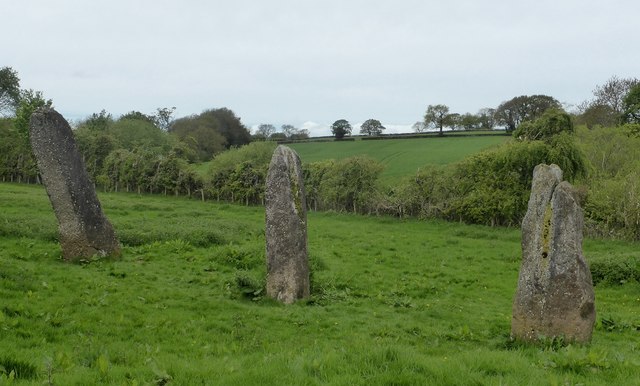
Harold's Stones is one of the most significant and atmospheric prehistoric megalithic monuments in Wales — and it is worth noting immediately that despite the listing suggesting South East England, the coordinates 51.74336, -2.72675 place this site firmly in Monmouthshire, Wales, near the village of Trellech (sometimes spelled Trelleck or Trelech). This small but remarkable alignment of three large standing stones is among the finest examples of a prehistoric stone row in the whole of southern Britain. The stones stand in a field just south of the village centre, arranged in a rough north-northeast to south-southwest line, and they have drawn curiosity, reverence and scholarly attention for centuries. Their sheer scale relative to the intimate, pastoral landscape around them gives them an immediate sense of drama and presence that lingers long after a visit.
The three stones vary considerably in height and character. The tallest reaches approximately four and a half metres above ground, making it an imposing sight in the gently rolling Monmouthshire countryside. The stones are composed of local conglomerate rock, a coarse, puddingstone-like material embedded with rounded pebbles, which gives their surfaces a distinctive texture — rough, pitted, and visually complex in a way that smooth granite megaliths are not. They lean at varying angles, giving the group an organic, unsettled quality, as though they have been slowly settling into the earth across the millennia. Lichen of grey, orange and pale green covers much of their surface, deepening the sense of immense age. Standing close to them, especially in low morning or evening light, their textures become almost sculptural, each stone revealing different patterns and colours.
The origins of Harold's Stones are prehistoric, most likely dating to the Bronze Age, though some researchers have suggested a Neolithic date is possible. Their precise purpose, like that of most standing stone alignments, remains a matter of scholarly debate. Astronomical alignments have been proposed, as have associations with territorial markers, ritual gathering places, or memorials to the dead. The spacing and orientation of the three stones have attracted the attention of archaeoastronomers, though no single convincing astronomical theory has achieved consensus. What seems clear is that they were erected with considerable communal effort and that the site held deep significance for the people who built it — the stones were not placed casually.
The popular name "Harold's Stones" is almost certainly a medieval or post-medieval folk etymology with no genuine historical connection to Harold Godwinson, the Anglo-Saxon king killed at the Battle of Hastings in 1066. One tradition claims the stones mark the graves of warriors slain in a battle involving Harold, but this legend has no credible historical basis and is typical of the way prehistoric monuments across Britain were later attributed to famous historical figures when their true origins had been forgotten. Another local tradition connects them to the devil, as with many prehistoric sites in the British Isles. The Welsh name for the stones, "Cerrig Harold," reflects the same naming tradition. Trellech itself, whose name is thought to derive from a Welsh phrase meaning "town of stones," grew up in the landscape shaped by these ancient monuments.
The surrounding landscape is quintessentially border-country Wales — a gently undulating agricultural terrain of green fields divided by hedgerows, with the village of Trellech sitting on a slight ridge above the valley of the River Wye to the east. The Wye Valley Area of Outstanding Natural Beauty lies very close by, and the broader landscape retains a deeply rural, unhurried character. Trellech is a historically layered village with more to offer than the stones alone: it contains the remains of a medieval mound known as Tump Terret, a holy well called the Virtuous Well (or St. Anne's Well), and a notable medieval church, St. Nicholas's, which contains a remarkable carved stone sundial and other historical features. Together, these sites make Trellech feel like a place of unusual density of history for such a small settlement.
Visiting Harold's Stones is a genuinely rewarding experience that requires no special equipment or preparation. The stones stand in a field accessible via a gate from the road south of the village, and the site is maintained by Cadw, the Welsh Government's historic environment service. The field path can be muddy in wet weather, so sensible footwear is advisable. The site is freely accessible at all times. There is limited parking in the village, and visitors arriving by car should be considerate of local residents. The nearest larger towns are Monmouth to the north and Chepstow to the southeast, both offering accommodation and services. The site is most atmospheric in early morning or at dusk, when the stones cast long shadows across the grass and the surrounding landscape feels especially still and ancient.
One of the more unusual aspects of Harold's Stones is how relatively little-known they remain outside Wales and specialist circles, despite being genuinely comparable in their scale and preservation to far more famous megalithic sites. They do not draw large crowds, and it is entirely possible to visit on a quiet weekday and have the field entirely to yourself. This sense of undiscovered-ness is part of their particular charm. The combination of the stones' physical impressiveness, the richness of the broader village heritage, and the beauty of the surrounding Monmouthshire countryside makes Trellech an exceptionally worthwhile destination for anyone with an interest in prehistoric monuments, Welsh history, or simply landscapes that carry a palpable sense of deep time.