Machynlleth Town Clock
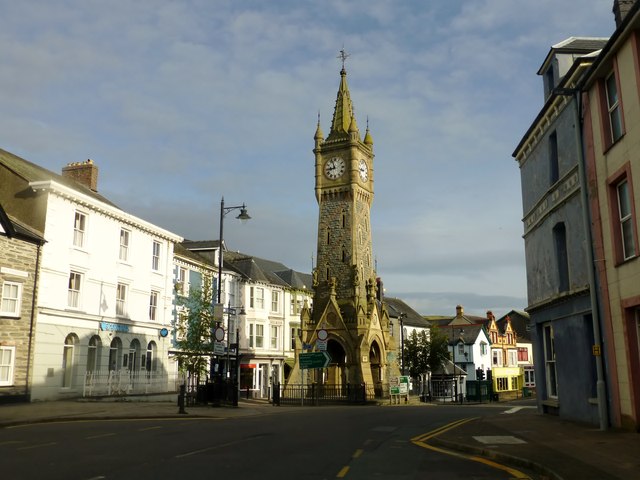
Machynlleth Town Clock is one of the most recognisable landmarks in mid-Wales, a striking Victorian clock tower that rises above the main street of the small market town of Machynlleth in Powys. Standing at the junction of Maengwyn Street and Penrallt Street, it serves as the symbolic heart of the town and is the first thing most visitors notice when they arrive. The clock tower was erected in 1874 to commemorate the coming of age of Viscount Castlereagh, the son and heir of the Marquess of Londonderry, who was the local landowner of considerable influence in the area at the time. This aristocratic connection gives the structure a slightly incongruous grandeur for such a compact market town, and it remains a point of civic pride for residents to this day.
The tower itself is built in an ornate Victorian Gothic style from local stone, rising to approximately 24 metres in height. Its design incorporates decorative stonework, arched openings, and the characteristic features of high Victorian civic architecture — a confident, slightly extravagant assertion of prosperity and permanence. The clock faces on all four sides were a practical gift to the town, allowing people going about their daily business in the market to keep time, and they continue to function and chime to this day. The chiming of the clock gives the town centre a particular rhythm, punctuating the quiet of the surrounding hills with a sound that has been familiar to generations of inhabitants of this part of the Dyfi Valley.
Machynlleth itself has a historical significance that far exceeds what one might expect from a town of its modest size, and the clock tower stands at the centre of that story. The town is famously associated with Owain Glyndŵr, the last native Welsh Prince of Wales, who held a parliament here in 1404 — a defining moment in Welsh history and a profound expression of Welsh national identity. The Parliament House, which is believed to stand near the site where Glyndŵr convened his assembly, is just a short walk from the clock tower along Maengwyn Street. This proximity means that visitors often encounter the clock tower as part of a broader pilgrimage through the town's medieval and political heritage, giving the Victorian structure an almost accidental role as a gateway to a much older story.
In person, the clock tower has a pleasingly solid, rooted presence. It does not dominate its surroundings so much as anchor them, giving the wide main street a focal point around which the rest of the town seems to orient itself. The stonework has weathered to a dignified grey-brown, and on bright days when the light falls across the valley, it can appear almost golden. The surrounding street is lively on market days — Wednesday has been the traditional market day in Machynlleth for centuries, a right granted by charter — and the clock tower becomes the natural meeting point, a place where people pause, consult the time, and set off in different directions. In quieter moments, particularly in the early morning or on a still winter afternoon, there is something genuinely atmospheric about standing beneath it.
The landscape surrounding Machynlleth is remarkable. The town sits in the Dyfi Valley, where the River Dyfi winds through a broad, lush glaciated valley flanked by the southern hills of Snowdonia and the northern reaches of the Cambrian Mountains. The surrounding countryside is deeply rural, with dense oak woodland, open moorland, and a powerful sense of remoteness despite the town's role as something of a regional hub. The Centre for Alternative Technology, a pioneering eco-centre founded in the 1970s, is located just a couple of miles north of the town and draws visitors with an interest in sustainable living and environmental technology. The nearby Dyfi Biosphere Reserve is one of UNESCO's recognised biosphere reserves in Wales, reflecting the ecological richness of the area.
Getting to Machynlleth is an experience in itself. The town is served by the Cambrian Line railway, one of the most scenic rail routes in Britain, running between Shrewsbury and Aberystwyth with a branch to Pwllheli. Arriving by train offers dramatic views of the Welsh uplands and the Dyfi estuary. By road, the A489 and A487 converge at the town, though the roads through the mountains can be challenging in winter. The clock tower is immediately visible on arrival and requires no particular effort to find. There are no access charges or restrictions — it stands freely on the public street — and visiting is possible at any time of year. Summer brings the most activity, but autumn, when the valley's oak woods turn copper and gold, is arguably the most beautiful season to visit.
One of the more curious aspects of the clock tower's story is how thoroughly it has become a symbol of Welsh identity and local distinctiveness, despite its origins as a monument to an English aristocratic family's dynastic milestone. The Londonderry connection has faded from popular consciousness while the tower itself has been absorbed into the fabric of a town that prides itself on its Welshness — Machynlleth has a notably strong Welsh-speaking community, and the clock tower appears on countless local photographs, festival posters, and pieces of civic material as an emblem of the place rather than its Victorian patrons. This quiet cultural reappropriation is, in its own small way, a rather Welsh story.