Maen Llia Stone
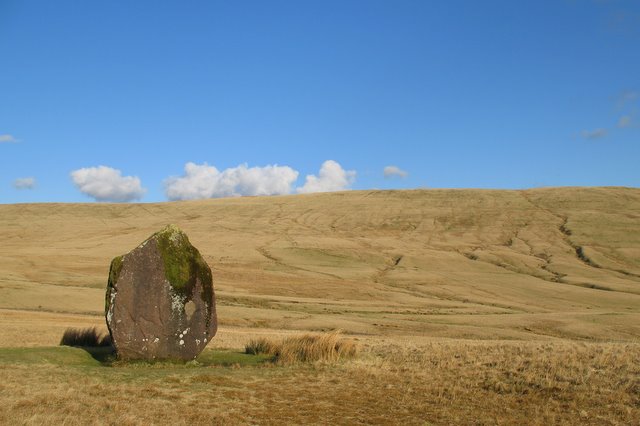
Maen Llia is a remarkable standing stone located in the Brecon Beacons National Park in Powys, Wales, rising from a remote upland valley with a solitary presence that has captivated visitors, scholars, and locals for thousands of years. It is one of the finest and most atmospheric prehistoric standing stones in all of Wales, a single monolith of striking proportions that commands attention against the wide, open moorland of the upper Llia valley. Its isolation and the grandeur of the surrounding landscape combine to make it one of those rare prehistoric monuments where the effort of reaching it feels entirely proportionate to the experience of standing before it.
The stone itself is a slab of Old Red Sandstone, the dominant geological material of the Brecon Beacons, and it stands approximately four metres tall, making it an imposing and unmistakable landmark. It is notably thin relative to its height, giving it an almost blade-like or fin-like profile when seen from certain angles, while from others it presents a broader, more massive face. The surfaces are weathered and textured, encrusted in places with lichen in shades of grey, orange, and green, the slow accumulation of centuries marking the passage of time on the stone's face. Up close, the rough gritty surface of the sandstone is tactile and immediate, a physical connection to the hands that may have touched it across millennia.
The date of Maen Llia's erection is not precisely known, but it is generally attributed to the Bronze Age, placing its origins somewhere between roughly 2000 and 1000 BCE, though some interpretations suggest an even earlier Neolithic context is possible. Like so many standing stones across Britain, its original purpose remains a matter of scholarly debate and honest uncertainty. Theories include its use as a waymarker along ancient trackways through the uplands, a ritual or ceremonial focus, an astronomical alignment point, or a territorial marker. The name itself is Welsh, with Llia being the name of the river and valley in which it stands, and maen simply meaning stone. Local folklore, as recorded in various Welsh traditions, holds that the stone moves of its own accord on certain nights, particularly going down to the nearby River Neath to drink at cockcrow — a legend that echoes tales attached to standing stones across Wales and beyond.
The surrounding landscape is exceptional and is itself a significant part of the experience of visiting Maen Llia. The stone stands in the valley of the Afon Llia, a tributary feeding into the upper Neath catchment, in an area of high, open moorland typical of the western Brecon Beacons. To the north and northwest rises the broad, rounded bulk of Fan Nedd, one of the distinctive flat-topped sandstone ridges characteristic of this part of the national park. The valley is boggy in places, crossed by the narrow mountain road known as the Sarn Helen route, which itself follows the course of a Roman road that traversed this high ground linking the Roman forts at Y Gaer near Brecon to those further south. The combination of prehistoric monument, Roman road corridor, and wild upland scenery makes this a place of remarkable historical layering. The Fforest Fawr Geopark, a UNESCO-designated geopark, encompasses this area, reflecting the geological and landscape significance of the broader region.
The road that passes close to Maen Llia is the narrow single-track mountain road running between Ystradfellte to the south and the A4215 to the north, and the stone stands very close to this road, visible from it and accessible via a short walk across rough ground. There is a small roadside layby or passing place nearby where visitors can leave a vehicle, though this is a narrow upland road and care should be taken. The walk to the stone from the road is minimal, crossing rough, potentially boggy moorland for just a short distance. Visitors should wear appropriate footwear and clothing for upland Welsh conditions regardless of the season, as the weather here can change rapidly and the ground is frequently wet. The stone is on open access land within the national park and there is no charge or formal visitor infrastructure — no interpretation panels, no fencing, no facilities. This is very much a wild and unmanaged encounter with a prehistoric monument.
The best time to visit is arguably in clear conditions with good visibility, when the full sweep of the mountain landscape can be appreciated alongside the stone itself. Early morning in summer can be particularly atmospheric, when low light catches the texture of the stone and the valley is quiet. Autumn brings rich, warm colours to the moorland vegetation. Winter visits in clear conditions, with perhaps snow on the higher ridges, can be dramatic and deeply atmospheric, though the access road may be affected by ice or snow. The area around Maen Llia is also notable for its dark skies, lying well away from significant light pollution, making the site one where, on a clear night, the prehistoric connection to the heavens feels vivid and immediate. The broader area around Ystradfellte, just a few kilometres to the south, is celebrated for its waterfalls — including Sgwd yr Eira, where visitors can walk behind the fall — making this part of the national park a rewarding destination combining prehistoric heritage with outstanding natural landscape.