Pill Priory
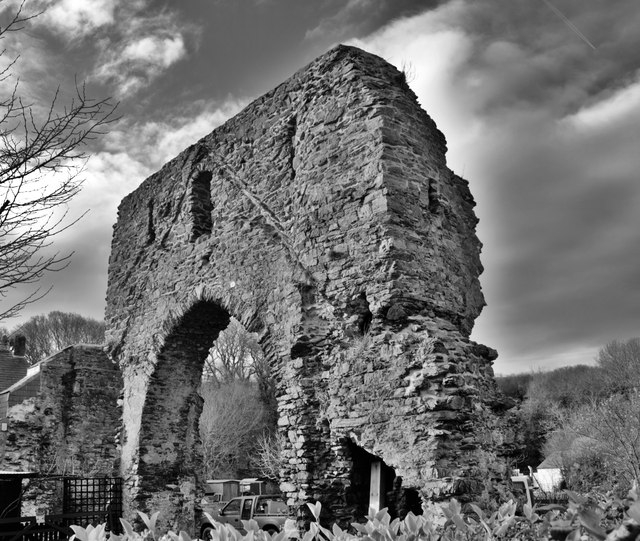
Pill Priory is a small but historically significant Augustinian priory ruin located near the village of Milford Haven in Pembrokeshire, southwest Wales. Situated on the western shore of the Daugleddau estuary, at a point where the waters narrow and the land drops gently toward the tidal margins, the priory occupies a quietly atmospheric site that rewards those who seek it out. It is not among the grand set-piece ruins of Wales — it lacks the dramatic towers of Tintern or the sweeping nave of Neath — but it possesses instead an intimate, almost secret quality that makes it genuinely compelling for visitors interested in early medieval monasticism and the layered religious history of Pembrokeshire.
The priory was founded in the late eleventh or early twelfth century by Adam de Rupe, a Norman lord, as a cell or dependent house of Pill, associated with the Tironian order — a reformed Benedictine movement that originated in France rather than the more commonly encountered Augustinian houses of the region, though some sources have at various times described different aspects of its affiliations. It was a small community throughout its existence, never housing large numbers of monks, and its fortunes fluctuated with those of its patrons and the broader political upheavals of medieval Wales. The priory would have functioned as a centre of prayer, modest agricultural activity, and service to the surrounding community during the medieval period, before succumbing to the general dissolution of the monasteries under Henry VIII in the sixteenth century. After dissolution, the buildings fell into decay and the stone was likely quarried for local construction, as was common throughout Wales and England.
What survives today at Pill Priory is fragmentary — sections of walling, remnants of the monastic church, and outlines of the ancillary buildings — but even in ruin, the site communicates a sense of age and stillness that is unusual. The stonework, where it remains, is of the warm grey-brown local character typical of Pembrokeshire medieval construction, patched with lichen and cushioned at the base by grass and low vegetation. The remains sit within a quietly sheltered setting, screened to some degree by mature trees and scrubby growth, which gives the place a tucked-away feeling, as though history has simply retreated here and been left largely undisturbed. In spring and early summer, the surrounding greenery is lush and the light filters through the canopy in a way that softens the ruins considerably.
The surrounding landscape is characteristically Pembrokeshire in its character — a patchwork of pastoral farmland, hedgerow-lined lanes, and the constant nearness of water. The Daugleddau estuary, sometimes called the "secret waterway" of Pembrokeshire, is one of the most ecologically and historically rich tidal systems in Wales, and Pill Priory sits within this broader cultural and natural landscape. The estuary is a drowned river valley, its shores lined with ancient woodland and mudflats that support significant birdlife, including curlew, redshank, and heron. The proximity to water would have been a deliberate choice for the priory's founders, as it offered both practical resources and a symbolic resonance that monastic communities frequently sought.
Reaching the site requires some effort, which is part of its charm. The priory lies in a rural area accessible via minor roads, and visitors should expect to navigate the narrow country lanes characteristic of this part of Pembrokeshire. There is no large visitor car park, and the site is not managed as a formal heritage attraction with facilities or interpretation boards in the manner of Cadw's principal sites. It is best approached as an exploratory visit rather than a structured heritage experience. The nearest town of any size is Milford Haven, which offers accommodation, fuel, and services. Pembroke and Haverfordwest are both within reasonable driving distance and offer a wider range of amenities. The site is most pleasant to visit in the drier months, roughly April through September, when the ground underfoot is less muddy and the vegetation, while sometimes overgrown, is at least vibrantly green rather than bare and waterlogged.
One of the more intriguing aspects of Pill Priory is precisely how little it is visited and how modestly it figures in the popular consciousness of Pembrokeshire tourism, despite the county's extraordinary richness of prehistoric, medieval, and natural heritage. For those with an interest in lesser-known monastic remains, or in the quiet persistence of the sacred in the landscape, the site offers something genuinely valuable: the chance to encounter history without crowds, without gift shops, and without the mediating apparatus of heritage tourism. It is the kind of place that repays slow, attentive visits, where imagination must do much of the work that interpretation panels do elsewhere, and where the sense of continuity between the medieval past and the living estuary landscape is unusually palpable.