Point of Ayr Colliery
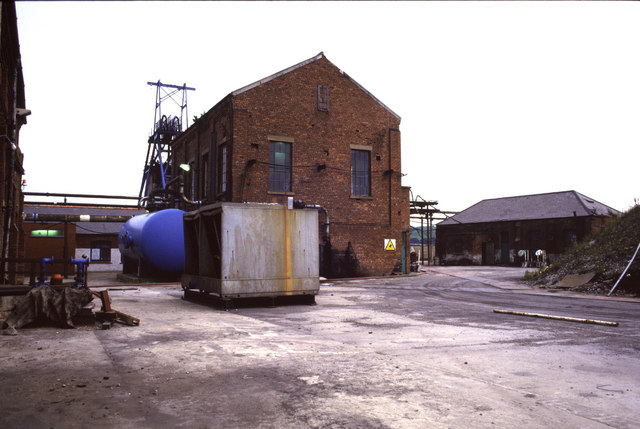
Point of Ayr Colliery, known locally as Talacre Colliery, was the last working deep coal mine in Wales, a distinction that gives it an extraordinary historical weight entirely disproportionate to its modest coastal setting. Located at the very tip of the Dee Estuary on the northeastern corner of Wales, the colliery sits at coordinates placing it within the community of Talacre in Flintshire, just a short distance from the Irish Sea. The mine closed in August 1996, bringing to an end a centuries-long tradition of coal extraction in Wales and marking a moment of profound cultural and economic significance for the nation. Today the site is partially redeveloped, with the most iconic remnant being the winding engine house and its chimney, which have been preserved as a heritage landmark and serve as a powerful reminder of the industrial past that shaped this corner of North Wales so completely.
The history of coal mining at Point of Ayr stretches back to at least the seventeenth century, when shallow drift mining was practised along the coastal margins of the Flintshire coalfield. The colliery as a substantial industrial enterprise developed significantly during the nineteenth century, eventually sinking shafts that reached considerable depths to access the rich seams of steam coal lying beneath both the land and the seabed. What made Point of Ayr particularly unusual among British coalfields was the extent to which its workings extended beneath the Dee Estuary and out under the Irish Sea, making it a genuinely sub-marine mine. Miners would travel underground and work in seams located beneath open water, separated from the sea only by the geological strata above them. This remarkable characteristic meant that the colliery occupied a unique engineering position, requiring constant vigilance against the risk of inundation and making the work there particularly demanding and psychologically taxing for the men involved.
At its operational peak, Point of Ayr employed several hundred men and was considered one of the more productive and technically advanced pits in the Welsh coalfield. The National Coal Board managed the colliery through the nationalisation era following 1947, and various modernisation programmes kept it productive well beyond the period when many of its contemporaries had already closed. The miners' strike of 1984 to 1985 affected the pit, as it did the entire British coal industry, but Point of Ayr continued to operate in its aftermath. Its final closure in 1996 came as part of the wider collapse of the British deep mining industry, driven by a combination of economic pressure from cheaper imported coal, reduced domestic demand, and government policy. The last shift was an emotional occasion, marking not just the end of one pit but the end of an entire national tradition.
In physical terms, the surviving heritage structures at the site are striking when encountered against their unlikely setting. The red brick winding engine house rises with considerable solidity and industrial confidence from a landscape that is otherwise flat, open, and dominated by sky and water. The chimney stack, similarly constructed in red brick, stands tall enough to be seen from considerable distances across the estuary and from the beach at Talacre. The overall aesthetic is one of Victorian and Edwardian industrial architecture meeting the raw, wind-scoured flatness of the coastal plain, and the combination is genuinely arresting. The surrounding area carries a quiet melancholy, the kind of atmosphere that attaches to places where a major human activity has ceased and the land has not yet fully decided what it wants to become next.
The landscape surrounding Point of Ayr Colliery is one of remarkable and often overlooked natural beauty. The Dee Estuary is a nationally and internationally significant nature reserve, designated as a Special Protection Area and a Ramsar wetland site of global importance. The vast mudflats and sandbanks exposed at low tide attract enormous numbers of wading birds and wildfowl, making this one of the finest birdwatching locations in Wales and indeed in Britain as a whole. Oystercatchers, dunlin, knot, and redshank gather in their thousands, and the sight of a large wader roost wheeling above the estuary at dusk is genuinely spectacular. The Point of Ayr RSPB reserve lies immediately adjacent, and the lighthouse at Talacre, a distinctive white-painted structure standing on the sandy shore, is another local landmark of considerable charm.
Visitors to the area will find the colliery remnants best approached from the village of Talacre, which lies a short distance inland. The beach at Talacre is popular with day-trippers from the towns of Prestatyn and Rhyl to the west and from the English side of the border, particularly during summer months. The former colliery site itself is on private land and portions of it have been redeveloped for industrial or commercial use, but the preserved winding engine house is visible from public vantage points and there has been ongoing discussion about its longer-term heritage use. The RSPB reserve and the coastal path provide excellent walking in the immediate vicinity, and the combination of industrial heritage and wildlife spectacle makes for an unusually rich visitor experience if you know what you are looking at.
One of the most compelling and lesser-known aspects of Point of Ayr's story is the sheer human dimension of working in a mine that extended beneath the sea. Former miners have spoken in oral history recordings about the particular sounds of the underground workings near the submarine sections, including the occasional groaning of geological strata and the awareness, always present at some level of consciousness, that the sea was above them. The colliery also had a tradition of being somewhat isolated from the main communities of the South Wales coalfield, belonging instead to the distinct North Wales coalfield, which had its own culture, its own union traditions, and its own sense of identity within the broader Welsh mining world. The closure of Point of Ayr therefore represented the end of this specific North Welsh mining tradition, a quieter and less documented chapter of Welsh industrial history than the great valleys of the south, but no less deeply felt by those who lived it.