Usk Priory
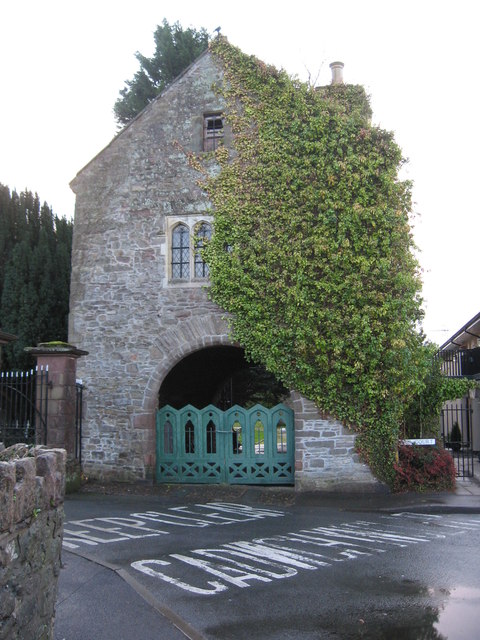
Usk Priory is a medieval religious house located in the small market town of Usk in Monmouthshire, south-east Wales, on the western bank of the River Usk in what is one of the most historically rich corners of the country. The priory is a Benedictine nunnery founded in the twelfth century, and the remains of its church — most notably the priory church of St Mary the Virgin — still stand and function as the parish church of Usk to this day, making it a rare example of a monastic church that survived the Dissolution of the Monasteries and continued in active religious use. That continuity of sacred function across nearly nine centuries is itself a remarkable achievement and one of the key reasons the site repays careful attention.
The priory was founded around 1135, traditionally associated with the de Clare family, powerful Norman lords who held sway across much of the Welsh Marches. It was established as a Benedictine house for nuns and remained a modest but functioning community through the medieval period. Usk itself was an important Norman stronghold — the nearby Usk Castle, a short walk from the priory, attests to the town's strategic significance — and the priory existed within this landscape of conquest and settlement. Like many religious houses of the March, Usk Priory occupied an uneasy frontier position between English and Welsh political worlds. The priory survived various upheavals of the medieval centuries before falling victim, along with hundreds of other monastic establishments, to Henry VIII's Dissolution in the 1530s. Unlike many dissolved houses whose buildings were quarried for stone or left to decay, the conventual church was preserved because it served the local parish community, a fate that saved it from the wholesale demolition visited upon so much of England and Wales's monastic heritage.
The church building that stands today is predominantly medieval in character, with fabric dating from the twelfth through fifteenth centuries. The tower is a particularly striking feature, a solid and commanding presence that has defined the Usk skyline for hundreds of years. Inside, visitors encounter a building that retains a genuine sense of antiquity — the stonework is worn, the proportions are those of a medieval craftsman rather than a later restorer's imagination, and the atmosphere is one of quiet accumulation of time. Fragments of medieval stone carving, ancient floor tiles, and memorials spanning several centuries give the interior a texture that rewards slow looking. The building has been subject to restoration work, as most churches of this age have been, but it has not been sanitised into blandness; the roughness and solemnity of the original structure remain legible throughout.
The town of Usk itself provides a fitting setting for the priory. It is a small, largely unspoilt market town clustered around a bridge over the river from which it takes its name, with a high street of Georgian and earlier buildings, a remaining gatehouse and tower of Usk Castle on the hill above, and the wide, shallow river running through meadows at its edges. The surrounding landscape is deeply pastoral — this is the Usk Valley, a broad, gentle river valley flanked by the rolling farmland and wooded hills of Monmouthshire, one of the greenest and least heavily visited corners of Wales. The Brecon Beacons (now Bannau Brycheiniog) National Park lies not far to the north, and the market town of Abergavenny is around ten miles upstream. The town sits roughly midway between Newport to the south and Abergavenny to the north, making it accessible from both the M4 corridor and from the Welsh heartland.
For visitors, the priory church is generally open during daylight hours, as is typical of many active parish churches in Wales and England, though it is wise to check locally before planning a specific visit. There is no admission charge, as the building is still a working Anglican parish church rather than a heritage attraction operated by a third party. Parking is available in the town centre, which is compact and walkable. The best approach for those without a car is via bus connections from Newport or Abergavenny, though services are infrequent and it is worth checking timetables in advance. Spring and summer visits are rewarding when the Usk Valley is at its lushest and the church is most likely to be open and accessible, but the town and priory have a particular atmospheric quality on quieter autumn and winter days when the tourist footfall is minimal and the medieval fabric seems to breathe more freely.
One of the more intriguing details associated with Usk Priory is the tradition that Adam of Usk, the medieval chronicler and lawyer who lived around 1352 to 1430, had connections with the town and its ecclesiastical life. Adam of Usk wrote a remarkable Latin chronicle covering the turbulent period of Richard II's deposition and the early Lancastrian years, and his account remains a vivid primary source for historians of the period. The priory's association with a figure who witnessed some of the most dramatic events of late medieval English and Welsh history adds a further layer of interest to a site that already sits at the intersection of Norman conquest, Welsh cultural identity, and the transformations of the Reformation. Visitors who take the time to look beyond the handsome exterior and read a little of the town's history will find that Usk Priory, modest as it appears, is woven into the broader story of the British Isles in ways that far exceed its size.