Marloes Sands Beach
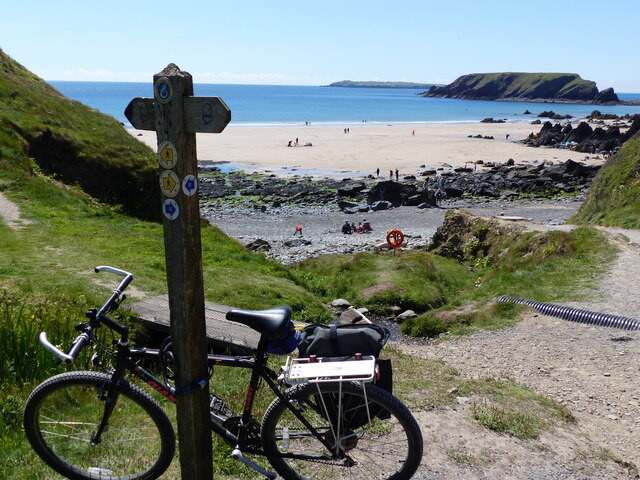
Marloes Sands is a sweeping, remote beach situated on the far western tip of the Pembrokeshire Peninsula in Wales, tucked into the southern edge of St Bride's Bay near the village of Marloes. It sits within the Pembrokeshire Coast National Park, one of the United Kingdom's most celebrated coastal landscapes, and is consistently regarded as one of the finest beaches in Wales and indeed in the whole of Britain. Its relative difficulty of access has helped preserve it from overdevelopment and mass tourism, giving it a wild, unspoiled character that rewards visitors who make the effort to reach it. The beach was designated as part of a Site of Special Scientific Interest largely due to its extraordinary geological exposures, and the surrounding coastline is protected under various conservation designations that reflect the exceptional quality of the natural environment.
The beach itself stretches for approximately one mile in a gentle crescent shape, backed by dramatic cliffs of red and grey Silurian and Old Red Sandstone that rise to considerable height and display complex folded strata visible in the cliff faces. The sand is medium to fine in texture, with a rich golden to pale reddish-brown hue that reflects the iron-rich geology of the region. At low tide the beach opens up considerably, revealing a wide expanse of firm, clean sand interspersed with rock pools, ridges of exposed rock running out to sea, and occasional beds of kelp and wrack along the water's edge. At high tide the beach narrows substantially and the sea pushes up to the cliff base in places, so timing a visit around the tide is genuinely important. The cliff faces themselves are a geologist's delight, showing folded and contorted rock layers laid down hundreds of millions of years ago, and the Three Chimneys — a famous geological feature consisting of vertical bands of harder rock standing proud of the cliff face — can be seen at the western end of the beach.
The waters off Marloes Sands are part of the broader St Bride's Bay system, which is open to Atlantic swells rolling in from the south-west. Sea temperatures are typical of the southern Welsh coast, sitting around 9 to 11 degrees Celsius in winter and rising to roughly 16 to 18 degrees Celsius in summer at their warmest, which is cool but manageable for hardy swimmers and wetsuit users. The tidal range in this part of Pembrokeshire is considerable, among the highest in the world by some measures, and the difference between high and low water can expose and then submerge large areas of rock platform and sand in the course of a few hours. Currents can be strong around the headlands, particularly toward Gateholm Island at the western end of the beach, and caution is warranted for swimmers who venture far from shore or around the rocky outcrops. On exposed southwesterly swells the beach can produce reasonable surf, though it is not a dedicated surf destination in the way that some nearby beaches are. The water quality is generally excellent and the beach has historically maintained good bathing water quality ratings.
Facilities at Marloes Sands are deliberately limited, preserving the wild character that makes it special but requiring visitors to be self-sufficient. There are no lifeguards patrolling the beach, which means swimming is entirely at the visitor's own risk and personal judgment is essential, particularly for families with children given the tidal range and the currents. There is a small National Trust car park at Marloes village, roughly a mile from the beach itself, with a modest parking fee applying to non-members. Toilets are available near the car park. There is no café or refreshment facility at the beach itself, and the nearest services are in the village of Marloes, which is small and has limited commercial amenities. The path down to the beach from the car park passes through farmland and along the coast path and can be muddy in wet weather; the final descent to the sand requires some care but is manageable for most reasonably mobile visitors. The beach is not easily accessible for wheelchair users or those with significant mobility difficulties due to the nature of the path and the rocky terrain.
The best time to visit Marloes Sands for a classic beach experience is during the summer months of June through August, when sea temperatures are at their highest, weather is most settled, and the long daylight hours allow extended visits. Even in peak summer the beach rarely feels overcrowded compared to more accessible Pembrokeshire beaches such as Tenby or Broad Haven, and early mornings or late evenings can feel genuinely solitary. Spring and early autumn offer excellent conditions for walking and photography, with dramatic skies, changing light on the cliffs, and fewer visitors. Winter visits can be spectacular in a raw, elemental way, with Atlantic storms producing impressive wave action against the cliffs and the light on the Silurian rock faces taking on rich warm tones, though access on the muddy paths becomes more demanding. Tidal timing is crucial regardless of season: arriving two to three hours after high tide on a falling tide gives the longest period of access to the full beach before the water returns.
Swimming, rock pooling and simply walking the length of the beach are the most popular activities, and the broad sand at low tide is excellent for informal ball games or kite flying given the open aspect and the reliable south-westerly breezes. Kayakers and sea kayakers use the area, and the launch point at nearby Marloes Haven — a small rocky cove just to the east — gives access to some outstanding coastal paddling. The Pembrokeshire Coast Path runs directly past the beach and walkers completing sections of this long-distance national trail pass through on their way between St Bride's Haven and Dale. The geological exposures on the cliffs and in the rock platforms attract amateur and professional geologists, and the Three Chimneys are a well-known landmark that appear in educational literature about Welsh geology. Wildlife watching is rewarding throughout the year, with choughs, ravens and peregrines nesting in the cliffs, grey seals visible offshore particularly in autumn and winter, and a rich intertidal community in the rock pools.
The surrounding landscape is one of the most dramatic on the Pembrokeshire coast. The cliffs to either side of the beach rise to around 30 to 50 metres in places, and the headlands of Deadman's Bay and Marloes Peninsula frame the view to the west. Gateholm Island, a tidal island accessible on foot at the lowest spring tides, sits at the western end of the beach and is of considerable archaeological and historical interest. The island shows evidence of a substantial early medieval settlement, with the remains of over a hundred hut platforms recorded on its surface, suggesting a significant monastic or secular community occupied it during the early Christian period in Wales. The island is a dramatic physical presence even when inaccessible, rising steeply from the sea and providing nesting habitat for seabirds.
Practically speaking, visitors should arrive at the National Trust car park at Marloes village, follow the signed footpath westward through the farmland and along the coast path for approximately 20 to 25 minutes on foot, and then descend to the beach via the established path. No entry fee applies to the beach itself, though the car park charges apply. Dogs are permitted on the beach and it is popular with dog walkers year-round. The nearest fuel, shops and restaurants are in Haverfordwest, roughly 12 miles to the east, or in the village of Dale to the south-east. Accommodation is available in Marloes village itself and in the surrounding area. Mobile phone signal can be patchy in this part of Pembrokeshire and visitors should not rely on connectivity for navigation or emergency contact, making a degree of preparation before arrival sensible.
The history of the Marloes Peninsula stretches back into deep prehistory, and the area around Marloes Sands was inhabited during the Iron Age, with evidence of ancient field systems and settlement on the peninsula. The name Marloes itself is thought to derive from a personal name combined with a Welsh or Norman element, reflecting the complex linguistic history of Pembrokeshire, which was long described as Little England Beyond Wales due to its historic Flemish and English settlement in the medieval period. The Dale Peninsula and the coastline around St Bride's Bay