Porthtowan Beach
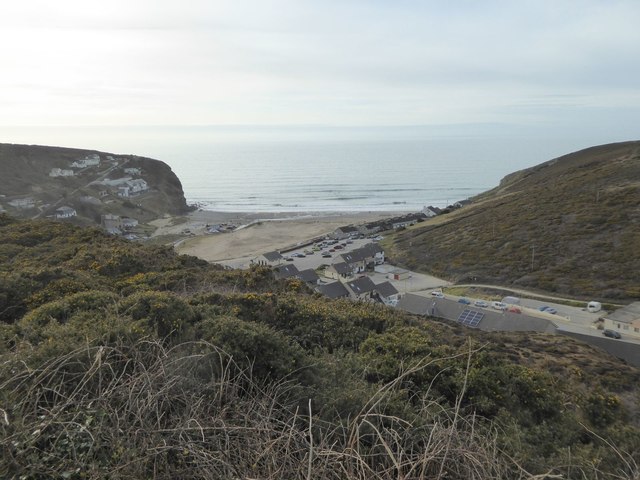
Porthtowan Beach is a popular Atlantic-facing beach situated on the north Cornwall coast of England, nestled between the villages of Portreath to the north and St Agnes to the south. It lies within the Cornwall Area of Outstanding Natural Beauty and sits close to the UNESCO World Heritage Site of the Cornish Mining Landscape, giving it a distinctive character that blends natural coastal beauty with the remnants of an industrial past. The beach draws visitors from across the UK and beyond, prized for its reliable surf, dramatic cliff scenery, and the relatively unspoiled quality of its surrounding environment. Despite being well known among surfers and families alike, Porthtowan retains a feeling of intimacy compared to larger Cornish resorts, partly because the village itself is small and the access road narrow.
The beach is a broad, golden sandy cove that sits at the base of steep valley sides, oriented to face the open Atlantic Ocean to the north-west. At low tide it reveals a generous and gently sloping expanse of fine, firm sand that stretches comfortably wide, making it suitable for everything from sandcastle building to ball games and sunbathing. At high tide the beach narrows considerably and the sea can reach the base of the dunes and the rocky outcrops that flank the cove, so visitors who arrive at mid to high tide will find a much more compact shoreline. Rocky reefs and ledges frame both ends of the beach, and these are worth exploring at low water for rock pools teeming with crabs, anemones, and small fish. The sand is generally clean and pale in colour, and the overall impression is of a classic Cornish surfing beach with a rugged, unsanitised charm.
The sea at Porthtowan is characteristically energetic, driven by Atlantic swells that funnel into the cove and produce consistent, well-formed waves that break across a broad surf zone. Swell heights vary enormously by season, with the largest and most powerful waves arriving in autumn and winter when Atlantic storms generate long-period groundswell. In summer, surf tends to be gentler and more manageable for beginners, though clean rideable waves are common throughout the warmer months. The tidal range on this stretch of the north Cornish coast is significant, typically between four and five metres, meaning conditions change rapidly and the beach looks and behaves very differently depending on the state of the tide. Sea temperatures follow the typical pattern for south-west England, hovering around 10 to 12 degrees Celsius in winter and rising to approximately 16 to 18 degrees Celsius at the height of summer. Rip currents can develop, particularly along the edges of the beach near the rocky flanks, and swimmers are strongly advised to stay within flagged areas when lifeguards are present.
Porthtowan is well served with facilities relative to its size, though it does not have the commercial infrastructure of a large resort town. The beach is patrolled by RNLI lifeguards during the main summer season, typically from late May through to September, and they operate a flag system indicating safe swimming zones. There is a surf hire and lessons operation available in season, making it accessible to beginners who want to try surfing without their own equipment. The clifftop and beach area have public toilet facilities, and there is a well-regarded beach café and bar, the Blue Bar, which has developed a reputation beyond simply being a beachside refreshment stop and operates as a music and events venue in the evenings during summer. Parking is available in a car park above the beach accessed via the village, but it is limited in capacity and fills quickly on fine summer days.
The best time to visit for a relaxed experience is outside the peak school holiday weeks of late July and August, when the car park can be overwhelmed by mid-morning and the beach becomes crowded. Late May, June, and early September offer a good balance of reasonable weather, manageable crowds, and a full complement of lifeguard cover and facilities. Surfers tend to favour the shoulder seasons and winter months for the more powerful swell, and the beach in a winter storm — when enormous waves crash against the cliffs and spray fills the air — is a spectacular and entirely different spectacle to the summer scene. Visiting at low tide gives access to the widest beach and the rock pool areas, and early morning arrivals in summer will find the sand at its best before it becomes busy.
Surfing is the defining activity at Porthtowan and the reason many visitors make a specific journey to the beach rather than stopping somewhere more convenient. The waves suit a wide range of abilities, from the gentler broken whitewater close to shore that is ideal for beginners and bodyboarders to the open-faced swells further out that reward more experienced surfers. Swimming is popular throughout the summer and is safest within the lifeguarded zones in the central portion of the beach. Rock pooling at the edges of the cove at low tide is a favourite family activity. The clifftop paths connecting Porthtowan to adjacent stretches of the South West Coast Path offer excellent walking, with views north towards Portreath and south towards Chapel Porth and St Agnes Head. Photography opportunities are exceptional, particularly in the late afternoon and evening when the Atlantic light falls dramatically across the cliffs.
The surrounding landscape is one of the most visually striking aspects of a visit to Porthtowan. The beach sits in a steep-sided valley carved through ancient Cornish cliffs of hard metamorphic and igneous rock, and the valley walls rise sharply on either side, giving the cove a sheltered, almost enclosed feel when viewed from the sand. The clifftops above and around the beach are covered with maritime heath and rough grassland, dotted in summer with heather and gorse. To the south, the headland of St Agnes Beacon rises prominently, affording panoramic views across a wide sweep of coastline. The geology of the area is ancient and complex, and the exposed rock faces within the cove display folded and fractured strata that speak to the immense geological forces that shaped this coast over hundreds of millions of years.
The industrial heritage of the area adds a layer of history that distinguishes Porthtowan from many other Cornish beaches. The north Cornish coast around here was once intensely active with tin and copper mining, and the ruins of engine houses and mine stacks are visible on the cliffs in the wider area, some of them forming part of the World Heritage landscape designation. The valley behind Porthtowan was itself associated with mining activity, and the small village grew up partly in connection with that industry. The beach was also historically used for landing supplies and small-scale boat activity, as was common for many Cornish coves before proper road infrastructure existed. While Porthtowan is not surrounded by the same density of mining ruins as some nearby locations such as Wheal Coates near St Agnes, the industrial landscape is visible on walks along the coast path and gives the area a sense of layered history beneath its modern reputation as a surf destination.