St Lythans Burial Chamber
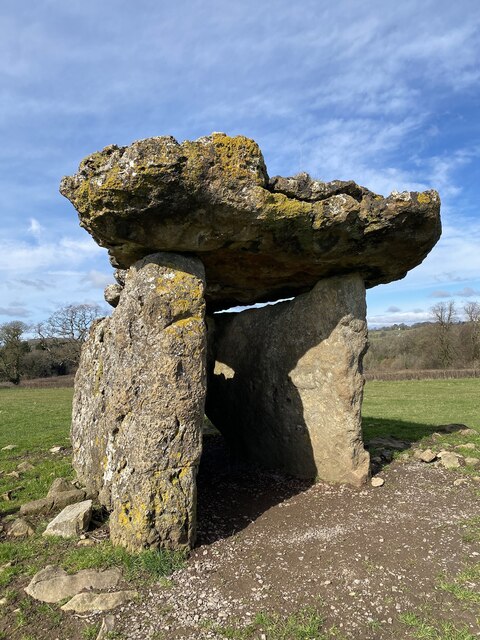
St Lythans Burial Chamber is a Neolithic megalithic monument located in the Vale of Glamorgan in South Wales, representing one of the finest and most complete examples of a prehistoric chambered tomb in the region. Dating back approximately five thousand years, to around 3000–4000 BCE, it is a cromlech — a type of dolmen or portal tomb — consisting of three upright standing stones supporting a massive capstone. The monument belongs to the same broad tradition as the better-known Tinkinswood burial chamber located just a couple of miles to the northeast, and the two sites are often visited together by those exploring the prehistoric heritage of this corner of Wales. St Lythans is a scheduled ancient monument protected by Cadw, the Welsh Government's historic environment service, and it stands as a remarkable survivor of an era when the farming communities of Neolithic Britain constructed elaborate communal tombs to house and honour their dead.
The chamber was originally covered by a long earthen barrow or cairn mound, though that covering has long since eroded and dispersed, leaving the stone bones of the structure exposed to the sky. The three uprights form a roughly rectangular chamber open at one end, and the capstone they support is a substantial, slightly tilted slab of local limestone, perhaps four metres in length, giving the whole structure that distinctive table-like silhouette characteristic of dolmens across Atlantic Europe. Archaeological investigation and analogy with similar sites suggest the chamber served as a collective tomb, with the bones of multiple individuals being interred over generations. It is thought the body or bodies may have been excarnated — stripped of flesh — elsewhere before the skeletal remains were placed inside, a funerary practice common in Neolithic communities. The monument reflects sophisticated communal effort and a deeply rooted relationship between the living and the dead in prehistoric Welsh society.
Welsh folklore has woven vivid legends around St Lythans over the centuries. The site is locally known as "Gwal y Filiast," which translates roughly from Welsh as "the Greyhound Bitch's Lair" or "the Lair of the Greyhound," a name connecting it to the mythological hound of the giant Llwyd or to spectral dogs associated with the otherworld in Celtic tradition. One persistent folk belief holds that on Halloween night, the capstone spins three times on its uprights and that the stones go down to drink from a nearby stream — a motif found at several ancient monuments across Wales and the British Isles. Another local story claims that wishes made at the site on Midsummer's Eve will be granted, and the chamber was once regarded as a place of enchantment and ill-luck for those who disturbed it. These layers of folklore sit naturally on a structure that predates written history by several millennia and whose original purpose has been entirely filtered through oral tradition.
In person, St Lythans has a quiet, intimate quality that contrasts with the grandeur of larger prehistoric monuments. The three uprights and capstone rise from a level, grassy field, and up close the sheer mass and weight of the capstone impresses itself upon the visitor — it is difficult to contemplate how Neolithic people moved and balanced such a stone using only timber, rope, and human effort. The surface of the stones is weathered and lichened, with textures of grey, green, and orange that speak to millennia of exposure. The field around it is generally calm; on a still day one hears birdsong, the distant lowing of cattle from neighbouring farms, and occasionally the soft sound of wind moving through grass and hedgerows. There is no roofed interpretation centre, no barriers, no queuing — the chamber simply stands in a small fenced enclosure within agricultural land, accessible and unadorned, which many visitors find deeply affecting.
The surrounding landscape is gentle, pastoral Vale of Glamorgan countryside — rolling green fields, hedgerows, scattered farms and copses, with the broad expanse of the Bristol Channel visible on clear days to the south, and the upland edge of the South Wales valleys faintly discernible to the north. The village of St Lythans itself is tiny, little more than a hamlet, with a small medieval church dedicated to St Bleiddian nearby. As mentioned, Tinkinswood burial chamber lies roughly two miles to the northeast and makes for an excellent combined excursion, the two monuments offering a rewarding comparison in scale and setting. The wider Vale of Glamorgan contains a surprising richness of prehistoric, Roman, and medieval heritage within a compact area, and the heritage trail connecting these Neolithic sites passes through genuinely beautiful Welsh farmland.
Getting to St Lythans is straightforward for those with a car. The monument lies south of the A48 and is accessible via minor country lanes from the village of Dyfan or from the St Lythans road. Parking is limited but a small lay-by or informal parking space is typically available near the access point, from which a short walk across or along a field path leads to the monument itself. There is no entry fee and the site is open year-round at all reasonable hours, being managed as an accessible heritage site by Cadw. Visitors should wear sturdy footwear, as the field path can be muddy in wet weather, which in Wales is a frequent state of affairs. The site is relatively small and a visit of twenty to thirty minutes is comfortable, though many people linger longer simply sitting with the stones. Spring and early summer bring wildflowers to the surrounding fields, making this perhaps the most visually appealing season to visit, while autumn mists give the site a more atmospheric and melancholy character that suits its ancient purpose well.